 Bluetick
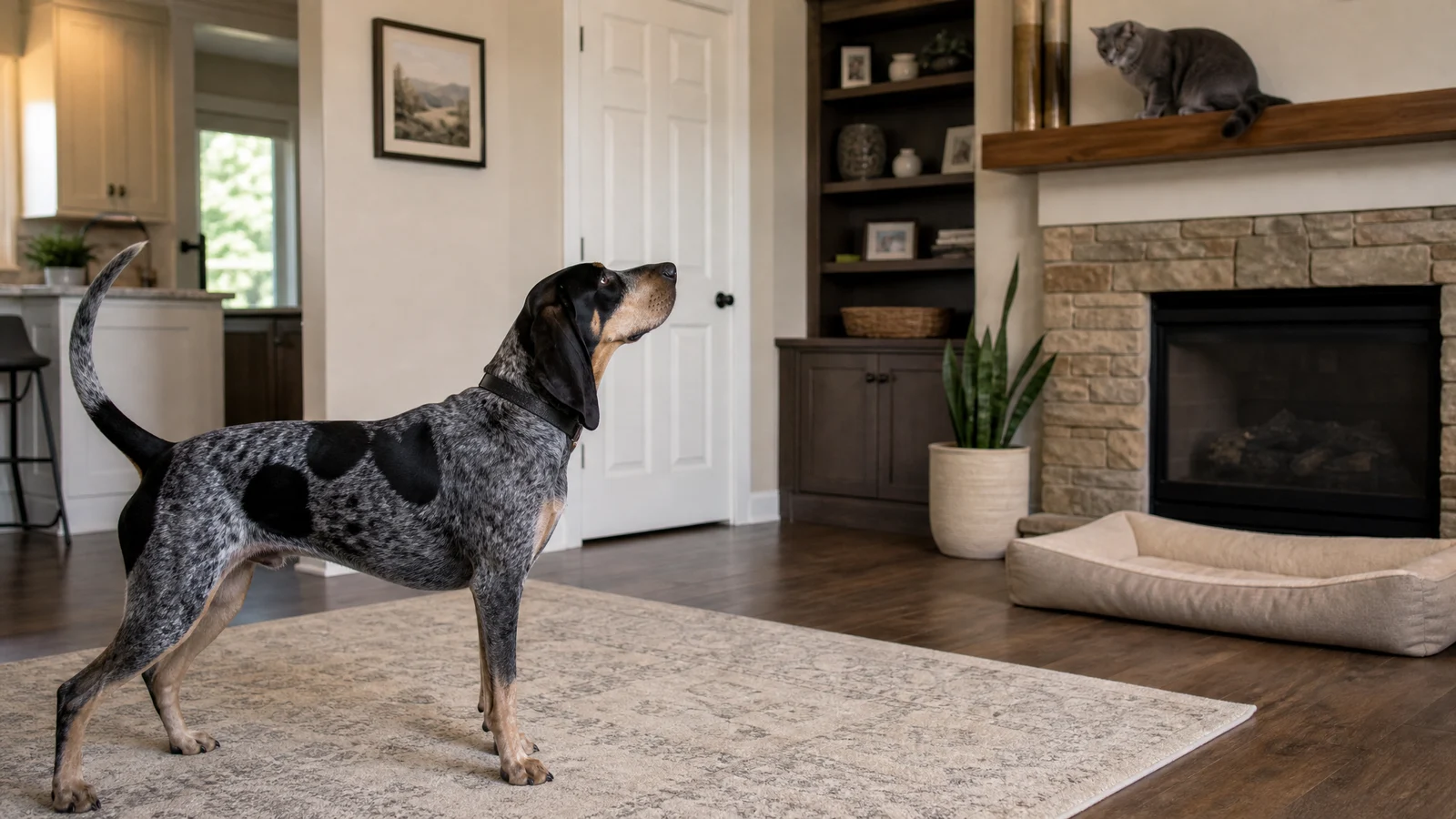
A young Bluetick Coonhound stands frozen in the living room, nose up, eyes locked on a cat perched across the room. You tell yourself they're just curious. Most homes with a young hound and a cat know that moment, and it deserves a second look, because what seems like curiosity is often the first beat of a trail.
The gap between a hound who is friendly and a hound who is cat-safe causes most of the trouble in mixed households: a bolting cat, a barking puppy, a home on edge. Handled well, you get a hound who snoozes at your feet while the cat grooms on the couch. We have trained Blueticks for many years, and the method below is the one we trust.
In this article, we explain why prey drive outlasts a sociable temperament, and how management, rewarded calm and gradual introductions help a young puppy and resident cats share a home.
Example Household for Cat Training
Consider a typical household: two adult cats who are used to running the place in a two-bedroom apartment, and a ten-week-old Bluetick Coonhound puppy about to arrive. Everything below follows this household, so you can borrow the pieces that fit.
Apartment living shapes the plan. There is no yard to burn off steam and no distance for a cat to retreat into, so every hallway is a potential chase lane. Your job is to turn the floor plan into zones. The second bedroom becomes the cats' refuge, with litter box, food, water and a tall cat tree. The living room becomes the puppy's zone, with an exercise pen, a bed and chews. Your own bedroom is where the puppy sleeps close to you at night.
Why start at ten weeks? A young puppy is small, easy to manage and still forming habits, so you can build an association of cats with calm and treats before chasing becomes a rehearsed routine. An adult or rescue Bluetick follows the same steps over a longer stretch. In both cases, the cats' comfort sets the pace.
Bluetick Coonhound Prey Drive Training
Your puppy will probably love every dog at the park, and that is exactly why cats catch owners off guard. The AKC rates the breed 5 of 5 for getting along with other dogs. Friendliness with dogs is a social skill. Chasing is a different system entirely, and it runs on its own switch.
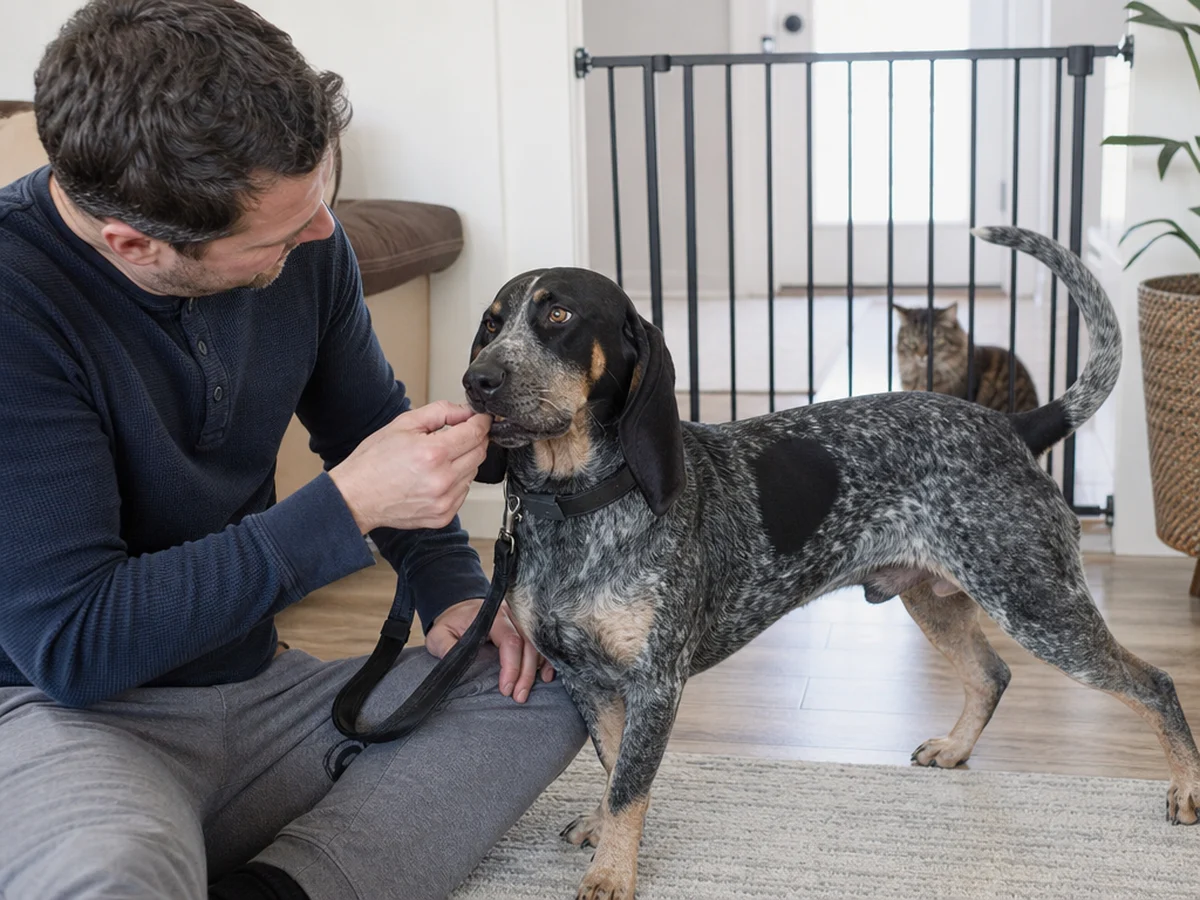
That same breed page describes their off-the-charts prey drive, which "must be channeled." Dogs read each other through posture, play bows and shared body language. A cat reads as something else: small, low, quick and prone to bolting. Blueticks were bred to trail and tree quarry.
The UKC standard describes a hound who is active, ambitious and speedy on the trail, with a free-tonguing voice (bawl, squall, chop or bugle) when striking and trailing. A dashing cat can switch on the nose, the legs and the voice in a heartbeat.
Learn to tell drive from curiosity. Curiosity wanders and sniffs, while drive narrows. Watch for these signs:
- Freezing with weight tipped forward and a stiff, still tail.
- A hard stare that doesn't break when you say their name or rattle a treat bag.
- Silent focus that turns into whining or baying as the cat moves.
- Lunging toward the cat the instant the cat runs.
Each of those is a cue to add distance, not to wait and see. Push back on the advice that a dog-friendly hound will sort things out with the cat on their own. They won't, and a cat who gets chased even once may never relax at home again. Channeling means you supply outlets, such as sniff walks and scent games, and you pay for the behavior you want. A hound with nothing to do will find a job, and the cat is the nearest candidate.
Week One Management Training
Training starts with management, because every rehearsed chase makes the next one stronger. In week one of our example, the puppy and the cats never share space without a barrier, and you set that up before the puppy walks in the door. Battersea advises complete separation for a stretch of two to three weeks at minimum, with careful introductions only after that, a sound floor for a hound with this much drive.
Doors, Gates and Pens
Use a closed door for the cats' room, not a baby gate. Cats clear gates easily, and a puppy who watches a gate all day is rehearsing fixation. In the puppy's zone, use a pen so you can step away without worry. Then rotate territory: puppy in the pen or your bedroom while the cats roam the living room, then cats back in their room while the puppy explores. The swap lets everyone learn the other's scent with no contact.
Leashes Indoors
Whenever the puppy leaves the pen, clip on a leash or a light drag line, especially near doorways and the hallway. A nose-led hound can bolt after a scent trail in a blink. Scatter treats on the floor as you walk so their nose has a better job than hunting for the cat.
Meals and Rest
Feed the puppy and the cats in separate rooms with doors closed, so mealtime becomes a happy routine on each side. Give the puppy chews and plenty of rest in the pen. A worn-out puppy settles, and a puppy who is overtired gets wild and loud.
Training Bluetick Coonhound Calm
Management buys time, but calm is what you actually teach, and you pay for it. Blueticks are smart and take well to treats, and a nose-led puppy will happily work for food scattered on the floor, so build every session around that. The goal is simple: the cat becomes a signal to check in with you, not a target.
Pay for calm looks. Whenever the puppy spots a cat across the room and then glances back at you, say your marker word right then and give a treat. Over repeated sessions, a look at the cat starts to predict a look at you.
Teaching a Settle Mat
Teach a mat as well. Reward lying down on a bed or mat in the quiet living room long before cats are involved. Later, pay for staying settled there while a cat strolls past the far end of the room, with a slow trickle of treats and a chew for longer stretches.
Distance is your dial. If the puppy keeps taking treats, can turn away and breathes easily, you are far enough. If they stiffen, stare or refuse food, you are too close, so walk away and try again from farther out. Stop each session on a calm note, while the puppy remains relaxed.
A hound whose nose is switched on tends to tune you out, so build a name response that always pays, as in our guide to making listening pay. If the puppy locks onto a cat anyway, use a calm interrupt: a cheerful cue, a step back and a treat for turning. If they can't settle, a short break in the pen with something to chew resets things without drama. Reward the cats too, with treats whenever the puppy appears, so both sides learn the other is good news.
Bluetick Coonhound Introductions
Introductions run in stages, and you move on only when the current stage looks boring. Because a Bluetick's prey drive is strong, don't rush to the next step, expect this phase to take weeks rather than days, and let the cats' comfort set the pace.
Scent Swaps First
Rub a clean sock on each cat's cheeks and let the puppy sniff it while you reward calm. Do the same in reverse with the puppy's blanket in the cats' room. Keep it casual and treat-rich.
Sight Without Contact
Next, let them see each other through a barrier. Keep the puppy on a leash at a distance, with the cat free to leave and with a high perch available. Pay for calm looks and settled breathing. These sessions are part of the separation, not meetings, because there is no sniffing and no chance to chase.
Leashed Meetings
When sightings bore everyone, bring the puppy within a few feet of a cat who chooses to stay. One person holds the leash and treats, and the cat always has an exit. Keep meetings short. If the puppy stiffens, stares or starts vocalizing, calmly lead them away and rebuild distance.
Loose in the Same Room
Only after many dull leashed meetings should the puppy be loose, and even then keep a drag line on and supervise every moment. When you can't watch, the barriers go back up. Given their drive, plan to supervise cat time for the long term, and treat that as a normal part of sharing a home with a scent hound.
Training Limits for Small Pets
Cats are large and quick enough to defend themselves and use high places. Hamsters, rabbits and birds are not, and to a scent hound they smell and move like quarry. The standard for these animals is stricter, and the limits are permanent.
Give small pets their own room with a door the dog can't open, and use cages with secure latches on solid furniture, not wobbly stands. Rustling bedding, a wheel at night and fluttering wings can trigger fixation and baying, and even a barred cage doesn't protect a small animal from the stress of a hound staring at them. Free-roaming time for a rabbit or a bird happens only in a room the dog never enters.
Know when to stop trying to mix them. If your Bluetick keeps fixating after many weeks, lunges at cages or goes silent and intent whenever the pet moves, treat that as a permanent separation, not a training failure. Calm when you are in the room is not proof of safety when you are out of it.
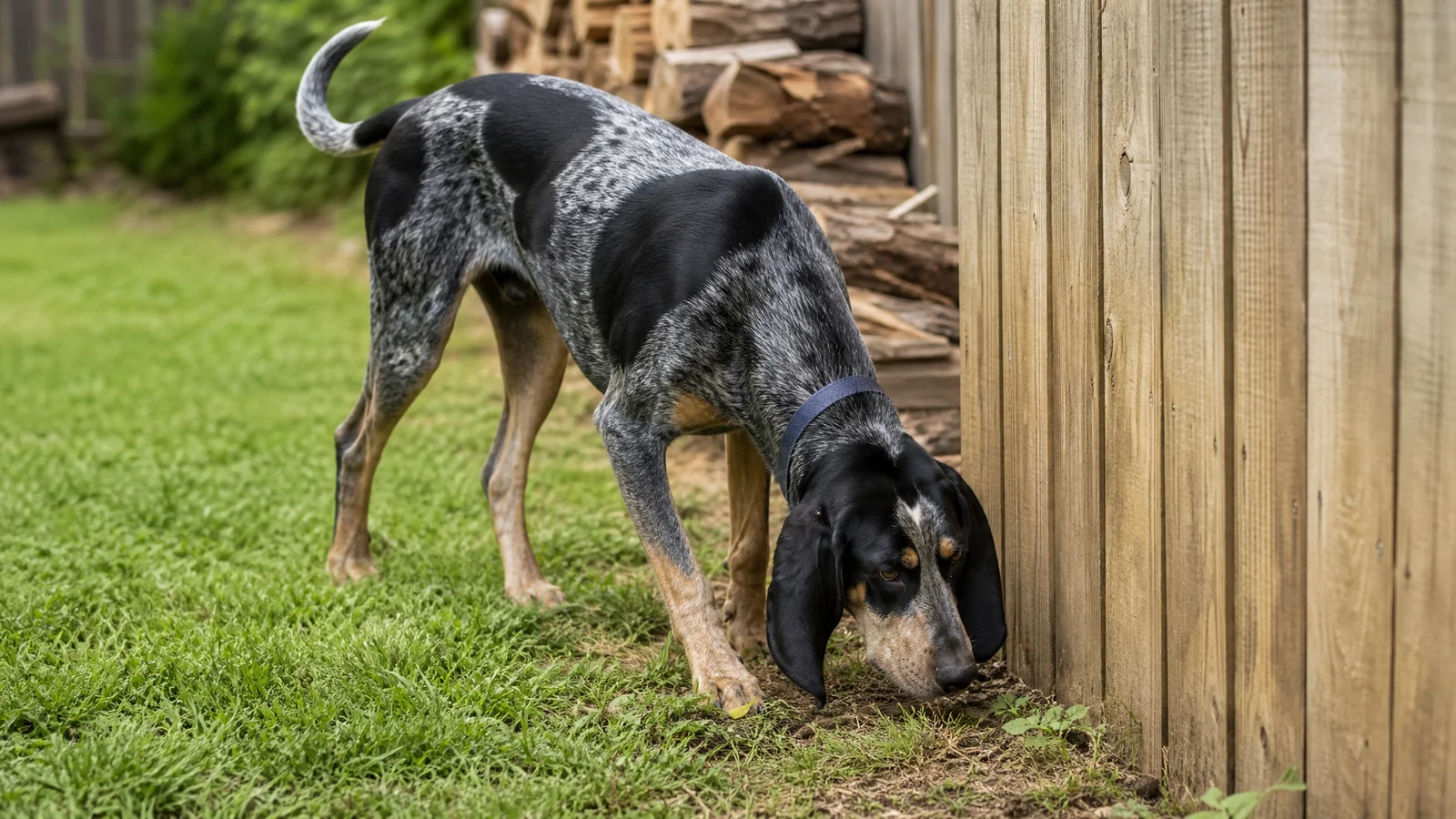
If a rabbit enjoys outdoor time, keep it in a space no hound can reach and make sure your own fence holds, as in our guide to securing your yard. Keep regular vet visits on the calendar for every animal in the house, and tell your vet about any sudden shift in the way your hound reacts to the others.
A Two-Week Cat Training Plan
Here is the plan for our example household, from the puppy's first day. It covers only the early stretch, and real meetings come later.
- Before the puppy arrives, set up the cats' refuge with a closed door and the puppy's zone with a pen.
- Keep the puppy on a leash or drag line whenever they leave the pen, and rotate territory so each side smells the other.
- Feed everyone in separate rooms and give the puppy chews and rest between short play sessions.
- Do the scent swaps with socks and blankets, rewarding calm sniffing.
- In week two, start short calm-reward sessions with the cat visible at a distance, paying for glances at you and settling on the mat.
- Hold the first leashed sightings from across the space, letting the cat leave whenever they like, and stop while the puppy is still calm.
The point of all this is that a Bluetick is friendly with dogs, devoted to their people and smart enough to learn, yet their drive never takes a day off. Management keeps the chase from becoming a habit, rewarded calm teaches the puppy that cats mean treats and a settled mat, and slow introductions respect the cats' pace.
Meet the hound's needs for scent work and exercise, keep small pets behind permanent barriers, and you will get a household where the cat naps in peace and the hound learns that the best job is the one you hand them.
 BehaviorSecuring Your Yard Against a Wandering Bluetick Coonhound
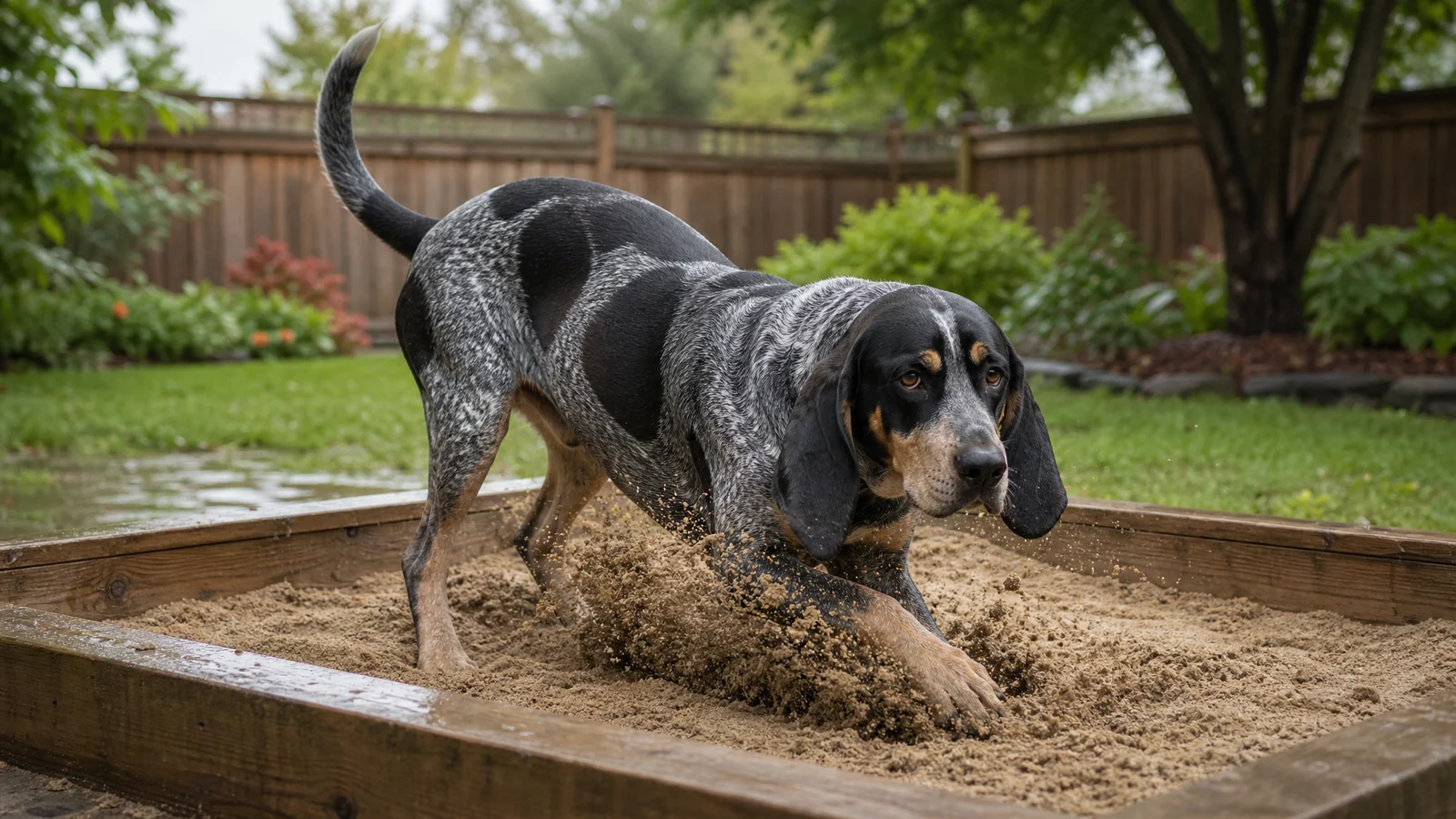 BehaviorGiving a Digging Bluetick Coonhound a Spot Better Than the Lawn
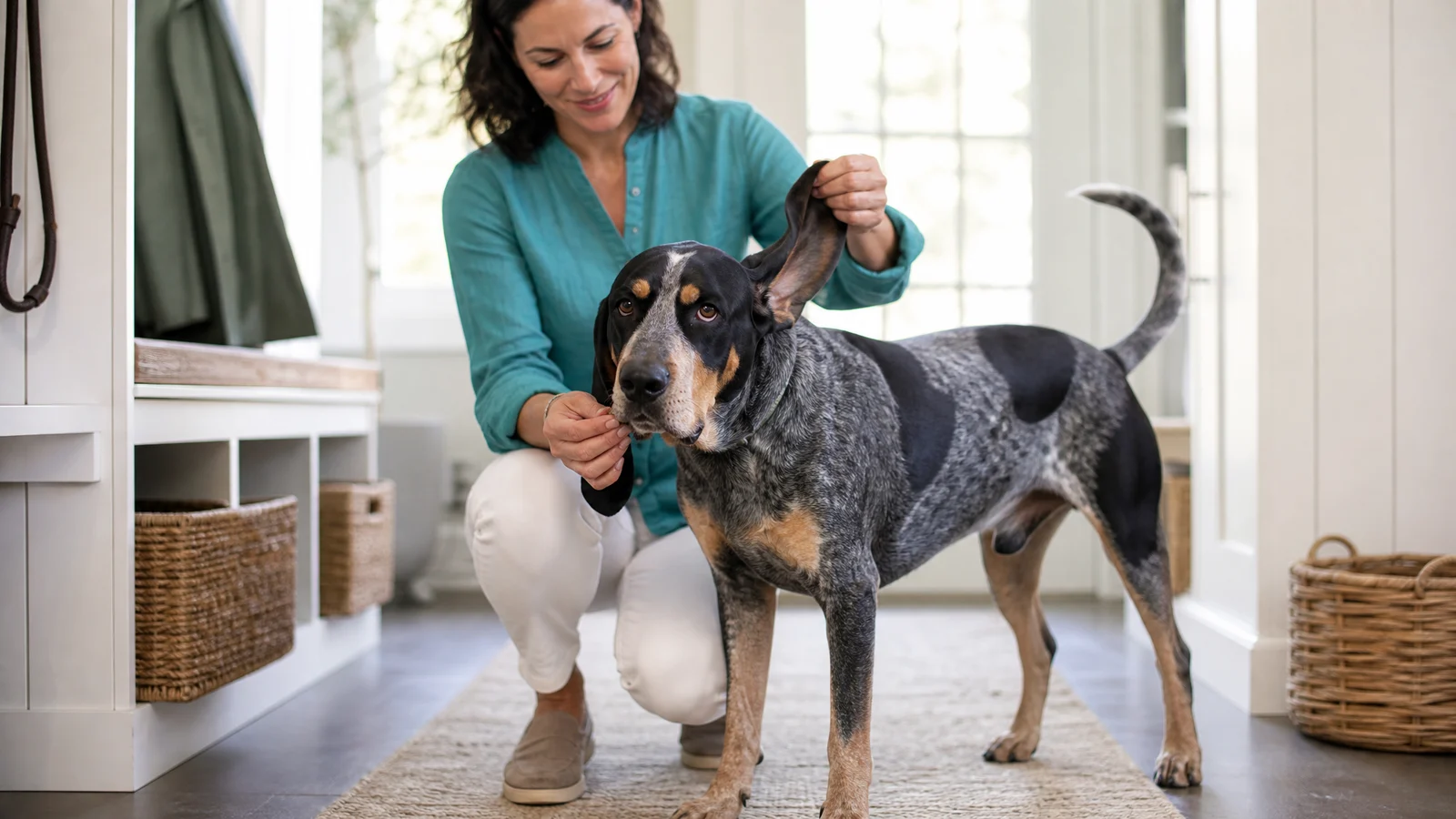 CareMaking Long Bluetick Coonhound Ears Easy to Check and Clean